




Company News
Panasonic R&D Center Singapore Won the AI Driving Olympics (AI-DO) at NeurIPS (formerly known as NIPS) 2018
December 8, 2018 | Project
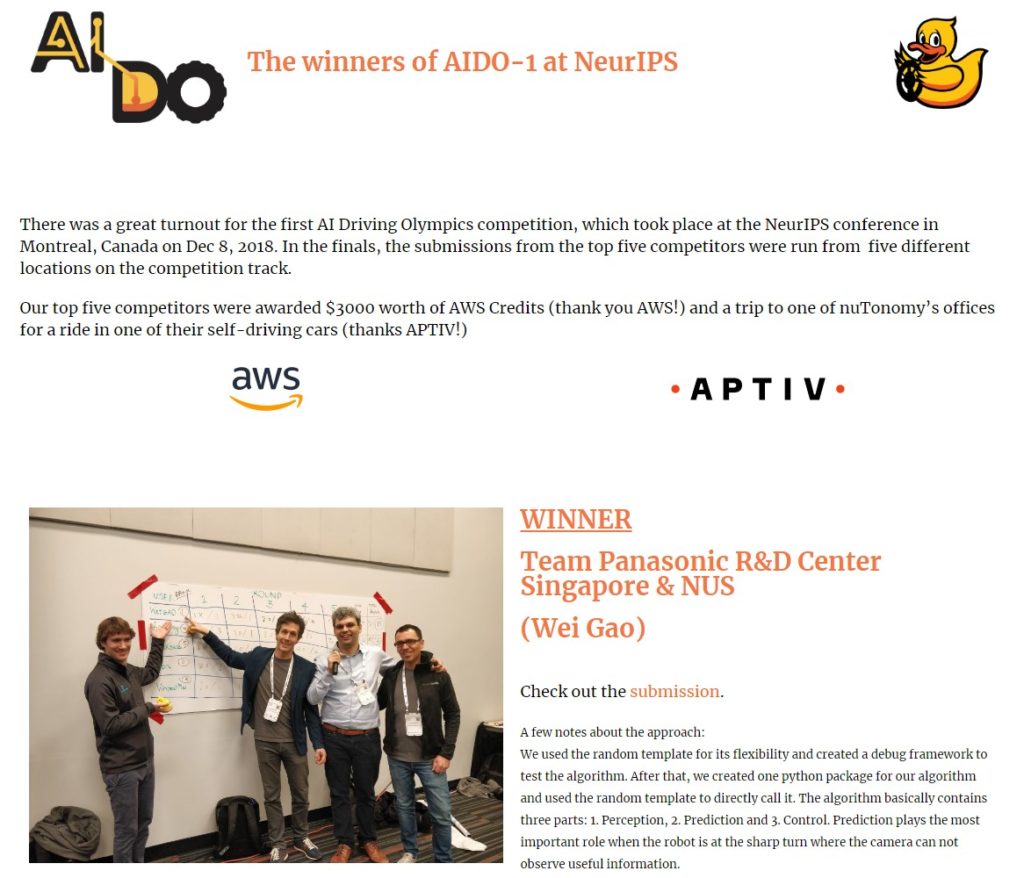
Panasonic R&D Center Singapore (PRDCSG) teamed up with the National University of Singapore (NUS) to partake in the inaugural AI Driving Olympics (AI-DO) competition, which took place at NeurIPS (formerly known as NIPS), a top-tier international conference in machine learning, in Montréal, Canada, on 8th December 2018. The Panasonic-NUS team cruised past all the competitors to secure the top spot.
Besting the other participants in the Leaderboards of Lane Following (LF) challenge and Lane Following with Vehicles (LFV) challenge utilizing the Duckietown platform, and subsequently during the live event at NeurIPS 2018, the Panasonic-NUS team was eventually crowned the Winner of the competition.
Reference: https://www.duckietown.org/archives/32095
Related Posts
Paper accepted for publication in the IEEE Transactions on Systems, Man, and Cybernetics: Systems
Collaborating with Nanjing University of Science and Technology (NUST), Panasonic R&D Center Singapore co-authored a paper titled “Modular Lightweight Network…
Read morePanasonic ranked #1 in Mugshot category of NIST FRVT 1:1 Challenge
PRDCSG once again kept Panasonic’s flag flying high in the global arena. In the latest Performance Summary of the NIST*…
Read moreIP Week @ SG 2016
The Intellectual Property Group (IPG) of Panasonic R&D Center Singapore (PRDCSG) participated, as one of the exhibitors, in IP Ecosystem…
Read morePanasonic R&D Center Singapore (PRDCSG) participated in the ITS World Congress 2019
Joining Panasonic’s booth at the ITS World Congress 2019 held at Suntec City of Singapore from October 21st to October…
Read more